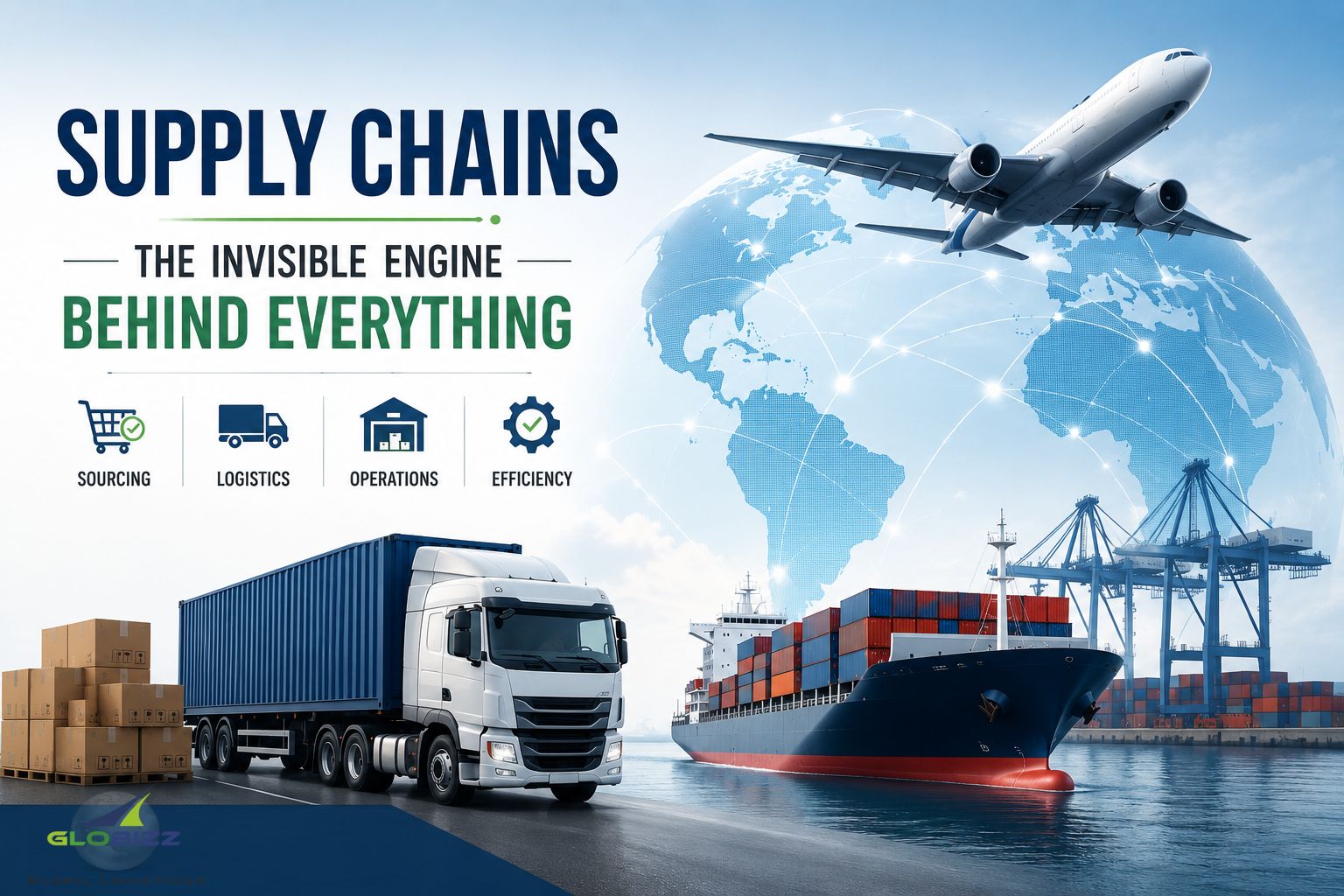
Every day, we depend on thousands of products without thinking about the incredible journey they take before reaching us. From the smartphone in your hand to the coffee on your desk and the medicine in your cabinet, every product is part of a carefully coordinated supply chain.
When supply chains operate efficiently, they remain invisible. Products arrive on time, shelves stay stocked, and businesses continue without interruption. But when disruptions occur, the effects ripple across industries and economies, making supply chains impossible to ignore.
What Is a Supply Chain?
A supply chain is the complete network involved in creating and delivering a product to the end customer. It includes every stage of the process, such as:
- Sourcing raw materials
- Manufacturing and production
- Warehousing and inventory management
- Transportation and logistics
- Customs clearance and international trade
- Distribution and last-mile delivery
Each stage depends on the one before it. A delay or disruption at any point can impact the entire chain.
Why Supply Chains Matter More Than Ever
Recent global events have highlighted how essential resilient supply chains are. Natural disasters, geopolitical conflicts, port congestion, labor shortages, and changing consumer demand have shown that even a small disruption can create widespread consequences.
Strong supply chains help businesses:
- Deliver products on time
- Reduce operational costs
- Improve customer satisfaction
- Manage inventory efficiently
- Respond quickly to market changes
- Minimize business risks
- Build long-term resilience
In today’s competitive environment, supply chain management has become a strategic advantage rather than just an operational function.
The Key Pillars of an Efficient Supply Chain
1. Strategic Sourcing
Selecting reliable suppliers is about much more than finding the lowest price. Businesses must evaluate supplier reliability, quality standards, sustainability, and long-term partnerships.
2. Smart Logistics
Efficient transportation ensures products move safely and cost-effectively across local and international markets. Choosing the right transport mode—air, sea, rail, or road—can significantly impact cost and delivery speed.
3. Inventory Optimization
Holding too much inventory ties up capital, while holding too little risks stockouts. Modern inventory planning uses forecasting and analytics to maintain the right balance.
4. Warehousing Excellence
Warehouses have evolved into intelligent fulfillment centers equipped with automation, barcode scanning, RFID technology, and real-time inventory tracking.
5. Technology and Data
Digital transformation has revolutionized supply chain management. AI, IoT, cloud platforms, predictive analytics, blockchain, and real-time visibility tools enable businesses to make faster, data-driven decisions.
Challenges Facing Modern Supply Chains
Despite technological advancements, businesses continue to face several challenges:
- Global supply disruptions
- Rising freight costs
- Regulatory compliance
- Demand fluctuations
- Sustainability expectations
- Cybersecurity risks
- Skilled labor shortages
Organizations that proactively manage these risks are better positioned to remain competitive.
Building Supply Chains for the Future
The future belongs to supply chains that are:
- Digital and connected
- Agile and adaptable
- Sustainable and environmentally responsible
- Customer-centric
- Data-driven
- Resilient against disruptions
Companies are increasingly investing in automation, predictive analytics, diversified supplier networks, and end-to-end visibility to prepare for future challenges.
Lessons Beyond Logistics
One of the biggest realizations about supply chains is that they are not simply about moving goods—they are about making better decisions.
Every sourcing strategy, transportation choice, inventory decision, and operational improvement contributes to business performance. Success depends on balancing cost, speed, quality, efficiency, and resilience.
Whether you’re managing global trade, overseeing logistics operations, or leading business strategy, understanding supply chain management provides valuable insights into how modern businesses create value.
Final Thoughts
Supply chains truly are the invisible engine behind the global economy. They connect manufacturers with markets, businesses with customers, and innovation with opportunity.
When they function seamlessly, they often go unnoticed. Yet their impact is everywhere—from the products we buy to the services we depend on every day.
As industries continue to evolve through digital transformation, automation, and global collaboration, supply chain professionals will play an increasingly critical role in shaping a more connected, resilient, and efficient future.
Because every product tells a story—and every story begins with a supply chain.